The Medieval Monster That Wasn’t
- Period
- 19th century
- Category
- Landmarks & Monuments
- The piece
- See the object
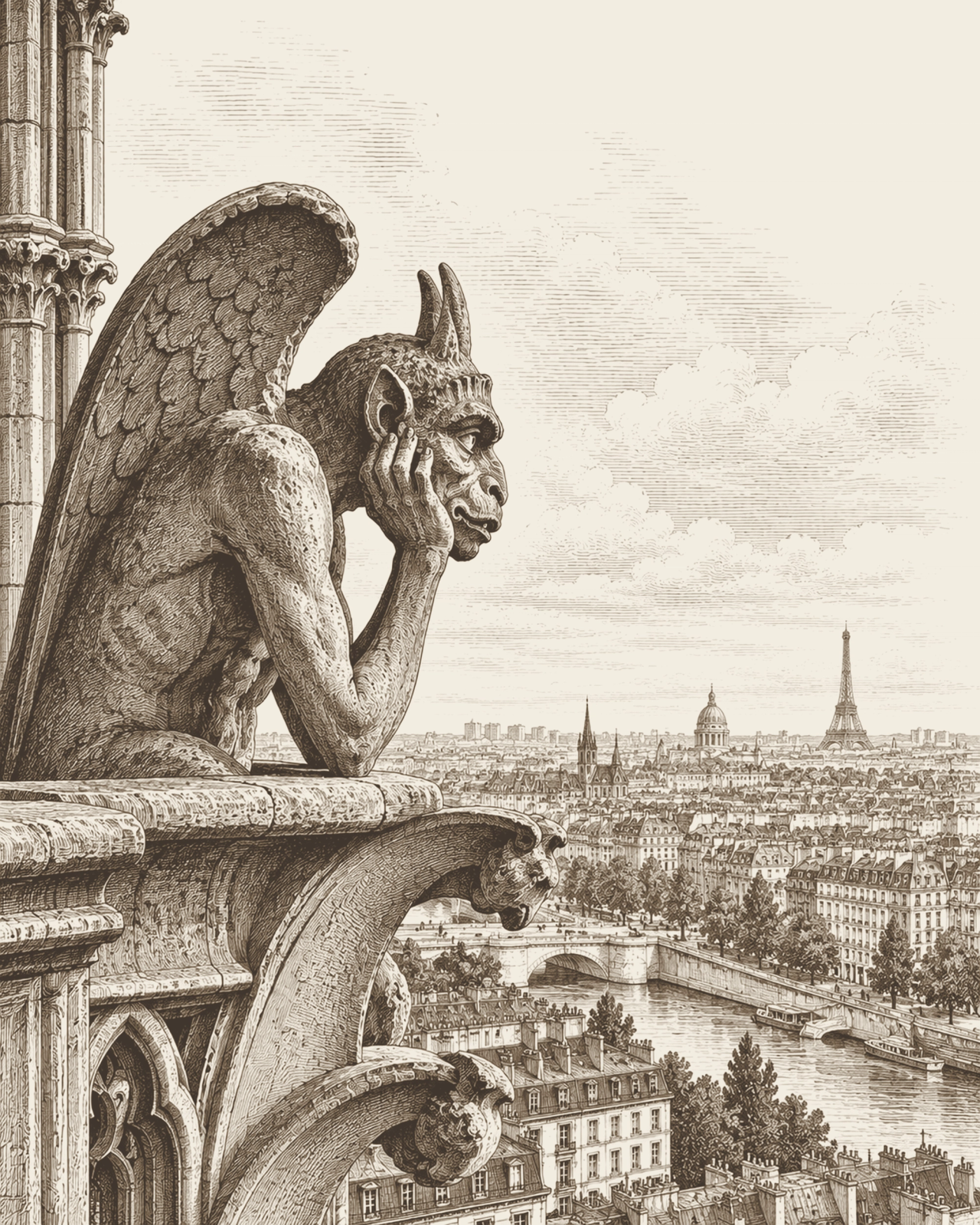
He sits with his chin in his hands, horned and hollow-cheeked, gazing down at Paris as if he has watched it for eight hundred years. Visitors photograph him by the thousands, and most assume he is as old as the cathedral he guards.
He isn't. Le Stryge was carved in the middle of the 19th century, nearly seven hundred years after work on Notre-Dame began.
A cathedral in ruins
By the 1830s, Notre-Dame was in poor shape. Centuries of weather had worn away its stone, and revolutionaries had torn the statues from its west front. The carved creatures of its medieval roofline had long since crumbled.
Victor Hugo's 1831 novel Notre-Dame de Paris changed the building's fortunes. Hugo made the cathedral a star, and his bell-ringer Quasimodo, clambering among stone monsters, gave readers a vivid picture of Gothic Paris. Pressure to save the real building followed. In 1844 the restoration went to two architects, Jean-Baptiste Lassus and Eugène Viollet-le-Duc.
Inventing the Middle Ages
The architects had little to copy, since only weathered fragments of the old sculpture survived. So they drew new creatures, borrowing from scraps on other Gothic buildings and from the Romantic imagination Hugo had helped inspire. Carvers turned the drawings into stone, and a new bestiary took its place along the Galerie des Chimères, the high walkway between the cathedral's two towers.
Le Stryge, carved around 1848–1850, became the most famous of them all. Even his designer is uncertain: the drawing may have been Lassus's rather than Viollet-le-Duc's.
Viollet-le-Duc made no secret of his approach. Restoring a building, he later wrote, could mean returning it to a complete state that may never have existed at any point in its history.
[Illustration 2, landscape 4:3. Le Stryge above Paris, with the city as context.] Caption: Illustration.
Famous by 1853
The stone was barely weathered before artists climbed up to meet him. In 1853 the etcher Charles Meryon published a print of the figure brooding over the rooftops, and titled it Le Stryge, after a vampire-like night demon of folklore. The name stuck.
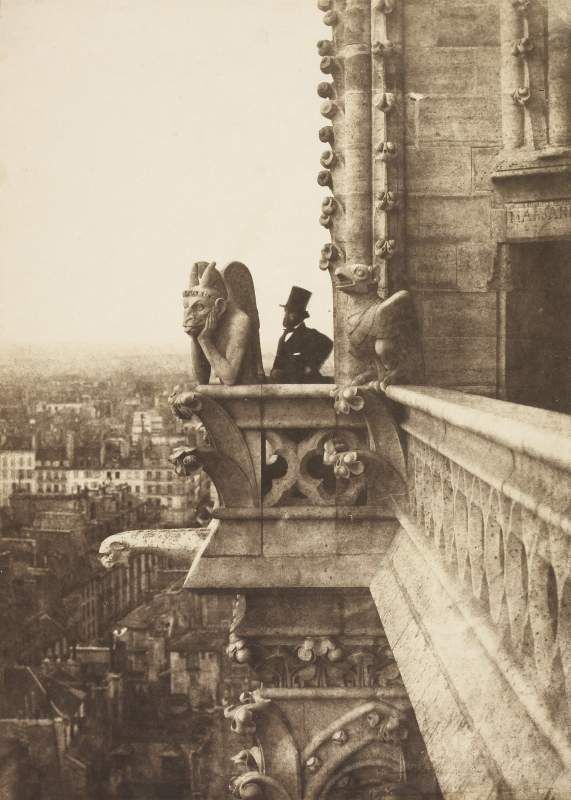
That same year, the photographer Charles Nègre posed his friend Henri Le Secq, top hat and all, beside the sculpture at the top of the north tower. Nègre sold the picture through the Paris dealer Goupil, and photographers, engravers and caricaturists soon borrowed it. Between them, the etching and the photograph turned a brand-new carving into an emblem of old Paris.
[Historical image: Charles Nègre, Le Stryge, c. 1853.] Caption: Historical image. The photographer Henri Le Secq beside the newly carved chimera, around 1853. Musée d'Orsay.
A past made in the present
More than 170 years later, Le Stryge is still mistaken for a medieval survivor. In a sense, that mistake is the story. Much of what we picture as the Gothic past was shaped by 19th-century hands, and their inventions have lasted long enough to become history in their own right.
The piece
The story above is the history of the Notre-Dame Chimera. This is the object in the collection that connects to it, and what is known about it.
Description
[Physical description to be supplied: material, size, condition and any distinguishing marks.]
Provenance
[Provenance to be supplied. Describe only what can be documented about this specific piece.]
Continue exploring
The whole collection
The Tower That Wasn’t Meant to Last
A Bridge Against the Odds
Story in preparation