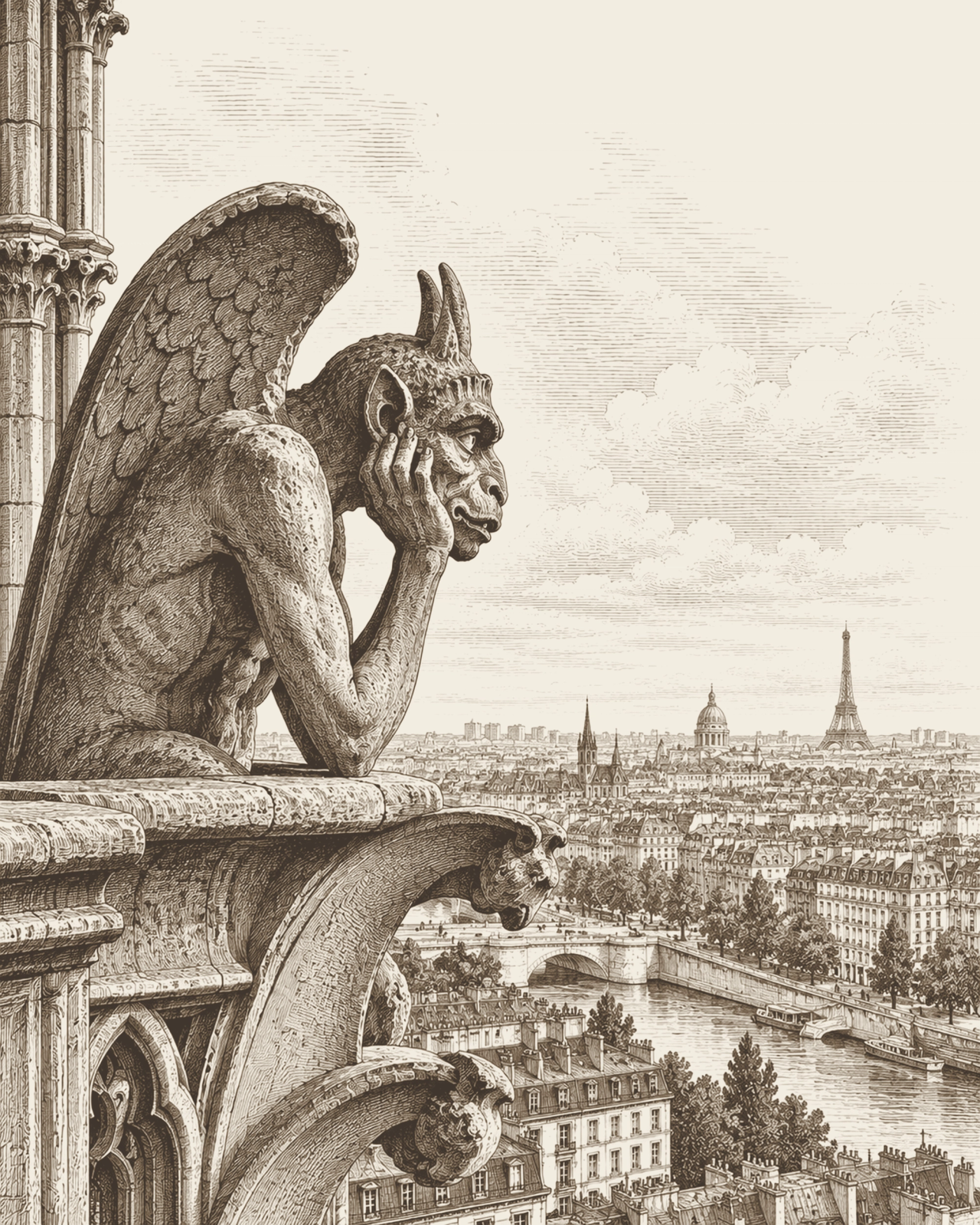
The Tower That Wasn’t Meant to Last
- Period
- 1887–1889
- Category
- Landmarks & Monuments
- The piece
- See the object
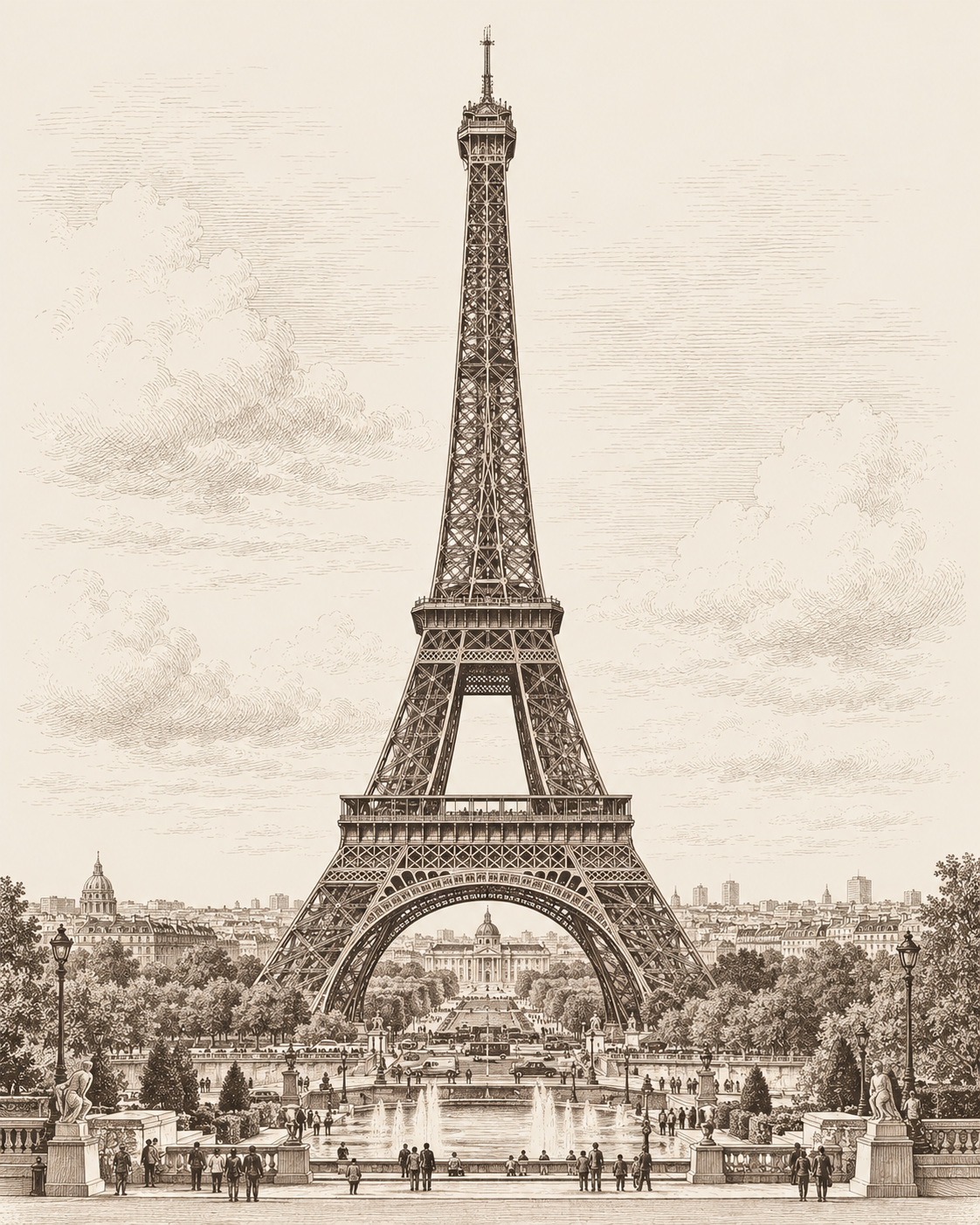
In the spring of 1889, Paris unveiled the tallest structure people had ever built. It was also, by the terms of its own permit, a temporary one. The agreement allowed Gustave Eiffel to run the tower for twenty years. After that it would pass to the city, which would be free to take it down.
That it is still standing has less to do with its beauty, which many Parisians doubted, than with something nobody could see at all.
A monument for a centenary
France planned the Exposition Universelle of 1889 to mark one hundred years since the Revolution, and the fair needed a centrepiece. The winning idea came from Eiffel’s engineering firm. Two of his engineers, Maurice Koechlin and Émile Nouguier, had sketched a 300-metre iron pylon in 1884; the architect Stephen Sauvestre softened it with arches and ornament. Eiffel acquired the rights to the design and championed it as his own.
A city objects
Not everyone welcomed it. In February 1887, weeks after work began, a group of prominent artists and writers published a protest in the newspaper Le Temps. Among the signatories were the architect of the Paris Opéra, Charles Garnier, the composer Charles Gounod and the novelist Guy de Maupassant. They saw the tower as an industrial intrusion on the city’s historic skyline.
The useless and monstrous Eiffel Tower
Eiffel answered that engineering had its own kind of beauty, and kept building.
Rising in record time
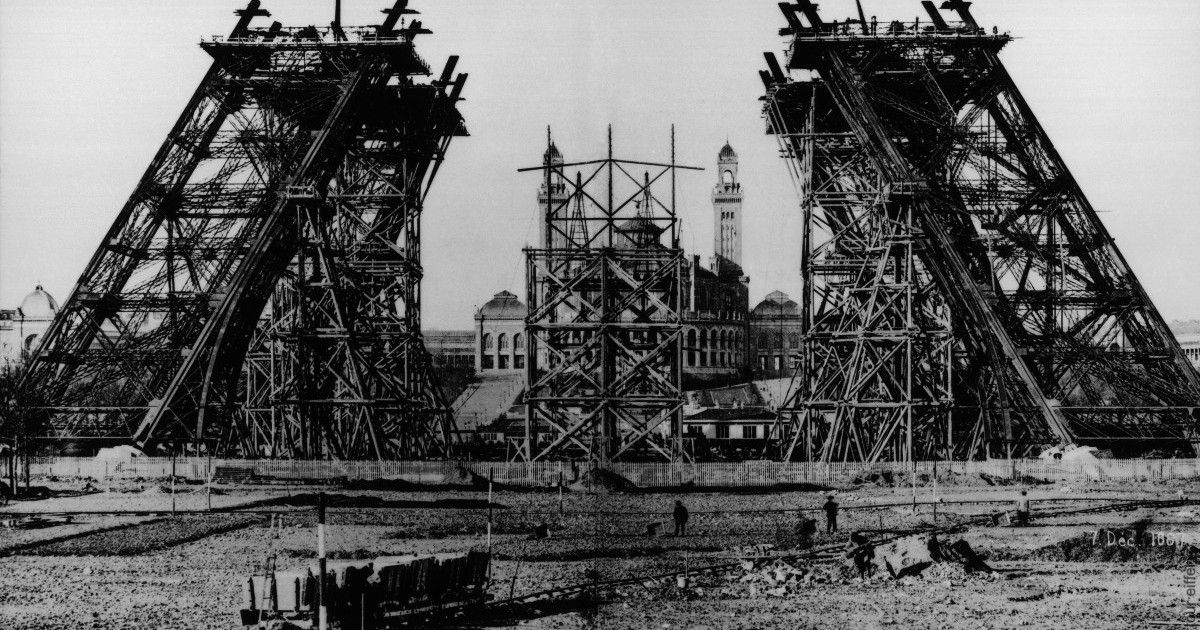
The tower went up with remarkable speed. Its parts were drawn and manufactured in advance at Eiffel’s works outside Paris, then riveted together on the Champ de Mars. On 31 March 1889, Eiffel climbed to the summit and raised the French flag. During the exposition that followed, nearly two million visitors made the ascent.
An expiry date
When the fair closed, the clock began to run. Temporary exposition buildings were routinely dismantled once their moment had passed, and the tower’s twenty-year permit would end in 1909. Eiffel understood that admiration alone would not save it. The tower needed a purpose.
So he turned it into a laboratory. He supported meteorological observations from the top, aerodynamic experiments dropping objects from the platforms, and, most consequentially, experiments with a new technology: wireless telegraphy.
The invisible invention
In 1898 the engineer Eugène Ducretet sent a wireless signal from the tower to the Panthéon, about four kilometres away. Eiffel then encouraged the French army to use the tower for military radio, and under Captain Gustave Ferrié a permanent station grew at its summit, its reach extending as the equipment improved.
A 300-metre iron mast turned out to be exactly what the new technology needed. The tower had become strategically valuable, and in 1910 its concession was extended. The structure that was meant to last twenty years was safe.
From sketch to permanence
- Koechlin and Nouguier sketch a 300-metre iron tower.
- Construction begins on the Champ de Mars.
- Artists and writers publish their protest.
- Eiffel raises the flag at the summit.
- First wireless transmission from the tower, to the Panthéon.
- The original twenty-year permit is due to end.
- The concession is extended. The tower stays.
During the First World War, the radio station on the tower intercepted enemy communications. Later it carried time signals and broadcasts. Antennas still crown it today: a reminder that the city’s most famous landmark owes its survival, at least in part, to waves no one can see.
The piece
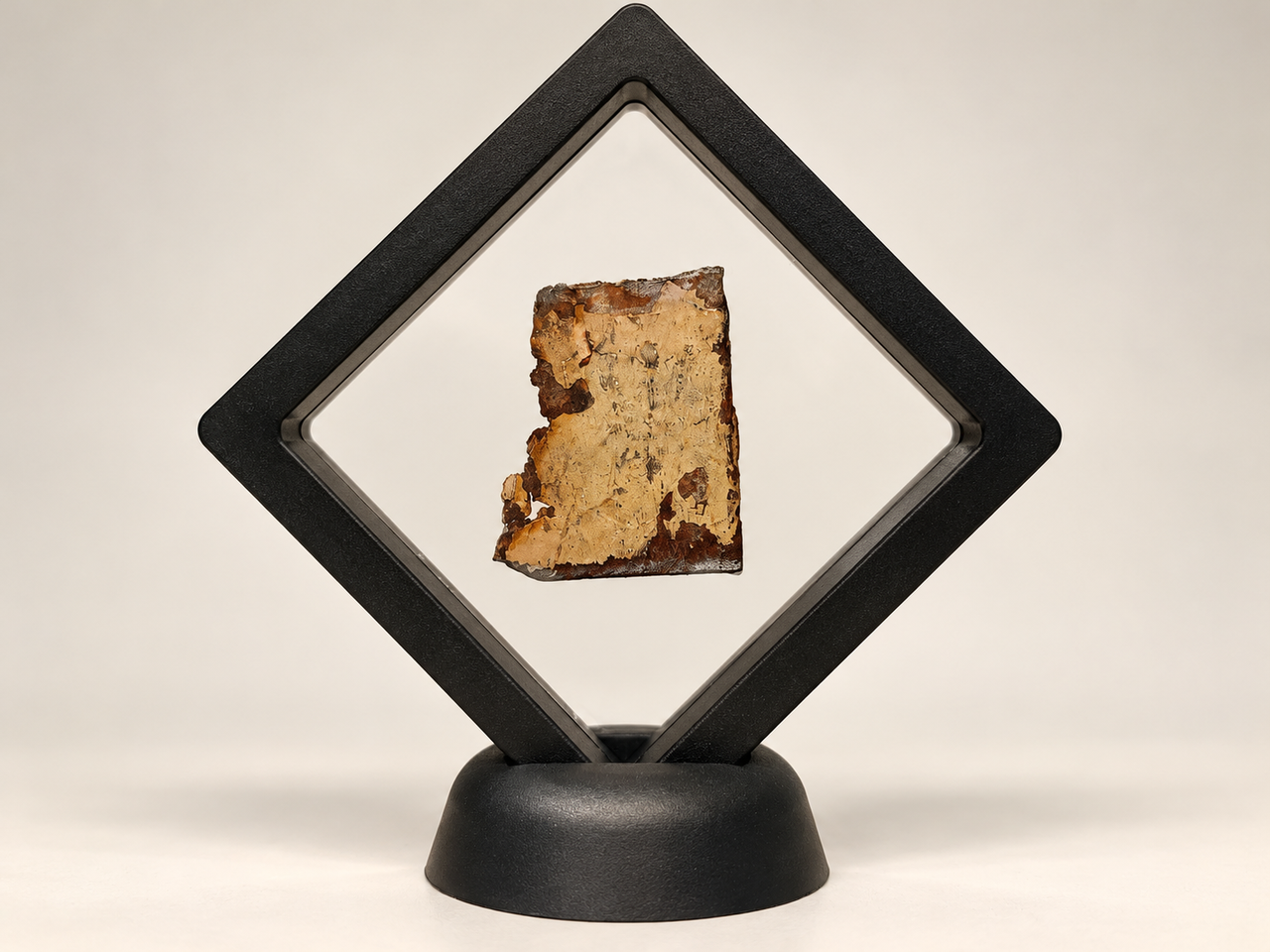
The story above is the history of the Eiffel Tower. This is the object in the collection that connects to it, and what is known about it.
Description
[Physical description to be supplied: material, size, condition and any distinguishing marks.]
Provenance
[Provenance to be supplied. Describe only what can be documented about this specific piece.]
Sources and further reading
- Jill Jonnes, Eiffel’s Tower (Viking, 2009). Suggested source: confirm edition before publishing
- Official website of the Eiffel Tower: history pages (Société d’Exploitation de la Tour Eiffel)
Continue exploring
The whole collection
A Bridge Against the Odds
Story in preparation